Saturday, September 8, 2012

Catching up...

Well, at last I'm in a guesthouse with a decent internet signal. I've covered a lot of territory since my last post, so this installment will be long.

This part of Turkey is crammed with ruins from the ancient Greek and Roman and Byzantine and Ottoman periods. The big concentrations of ruins are set off for tourists, but otherwise ancient remains simply litter the countryside. People casually incorporate ancient ruins into their houses, goat herders build them into their shelters, and bits from one ancient site have been incorporated into later ones.

Here, in the center of Selcuk, the Roman aqueducts are spread across town and into the hills beyond. Some of the buildings use them for walls. And the storks nest on the tops.


All of this gives the locals an up-close-and-personal sense of history we can't imagine.

When I last wrote, I was getting ready to visit Ephesus, probably the best preserved Roman town in the world. And it was really impressive, despite the frightening number of people visiting.


This is the famous library, somewhat askew. At once time, it was the third-largest in the world.

But plenty of more--shall we say--intimate remains are preserved.


Yes, this was the public toilet. People had bathrooms in their homes (as well as central heating from hot water piped under the floors), but the public toilet was a place where men met to socialize. The wealthy would get their slaves to save their spaces and warm the marble before they arrived.

Getting back to higher culture, the Temple of Hadrian has some remarkably well preserved carving, including this archway featuring Medusa.


After a long, hot day in the ruins, I accepted the opportunity to have dinner at my hosts' fancy pension in the hills outside of town. Watching the sun set over Selcuk Castle as I ate a wonderful traditional dinner was a fine way to end the day.


Tuesday, September 4, 2012

Getting ready to visit Ephesus!

I'm enjoying Selcuk, the town near Ephsus, and staying in a very nice pension run by a charming family, who don't include tech saavy among their charms. So I'm not sure whether I can even post this update on their sluggish internet. No hope of pictures! But all is well and I'm looking forward to seeing Ephesus this morning.

Those who know me may be shocked to hear that I've signed on to a guided tour. After trying to see Pergamon with by reading a guidebook and eavesdropping on passing tour groups, I've decided it's worth splashing out for Ephesus. The context is a big help when you're looking at ruins.

This town is famous for storks that nest on the tops of the old Roman aquaducts. Alas, they've just migrated back to Africa, so I can't provide any stork photos for Uncle Dean, our great family birder.

More when I have better internet...

Monday, September 3, 2012

Bergama in Greece---er, I mean Turkey

I love this charming little market town, but I keep thinking I'm in Greece. (Hi, Maria! I'm waving across the Aegean at you.) The houses and the people are really a lot like some of the towns on the Greek islands. And I'm not complaining.


This part of Turkey would be really exciting to those interested in Christian history. I keep running across places I heard about in Sunday School. The Red Basilica here in Bergama is mentioned in Revelations as one of the seven churches of the Apocalypse, and Satan himself is supposed to have a throne here. If so, he's probably finding it a bit drafty.


I also visited the Asceplion today, where Galen, the Greek physician, practiced. The remains are very impressive, and even more impressive is how unregarded they are. I haven't been to a lot of historical sites where you can sit on an overturned 1st century column to eat fresh figs, which I did. (Given to me by a kindly woman who was collecting them from the tree in front of her house.)

Back in the village, it seems to be market day. Bergama was sleepy when I arrived, but bustling today. The food here is amazing: fresh made or freshly brought in to market. Melons, tomatoes, beans, everything...


And the Turks do love their bread. It comes with every meal and bakeries are everywhere. I haven't eaten this much white bread ever. But it's delicious.


This has been a lovely, relaxing place to visit and I think I've finally overcome jet lag. Tomorrow I move on to Selcuk, the modern town near the ruins of Ephesus, another place out of Christian history. More Roman ruins!

Sunday, September 2, 2012

I'm tired tonight and the internet is pokey, so this update will be short and sweet.

I got to Bergama without any trouble. Turkey is like a European country: well-organized and efficient. I went smoothly from bus to plane to bus to bus to this charming, Agean-like town.

And then I hiked up a hill and took a cable car (shudder! never again!) up, up, up to the ruins of Roman Pergamon.


It was hot, shadeless, and wonderful.

I'm staying in an enchanting guesthouse. This part of Turkey is reminiscent of Greece and I have a room in a whitewashed old house up a narrow, cobbled lane. It's simple and simply charming. And now I'm going to fall sideways into my beckoning bed. For once, the sideways photo is correct.

Saturday, September 1, 2012

After three days in Istanbul, I can answer the question so many people asked before I left: Yes, it's dangerous here. And all of the danger can be summed up in one word: traffic.

These narrow cobbled streets were never meant for cars, much less hulking tourist buses. One-way signs mean nothing. In many places, the streets are lined with cast-iron bollards to keep the sidewalks from becoming roadways. Sidewalks, if they exist at all, vanish without notice. The only saving grace is that most of the time the cars are immobilized by jams.

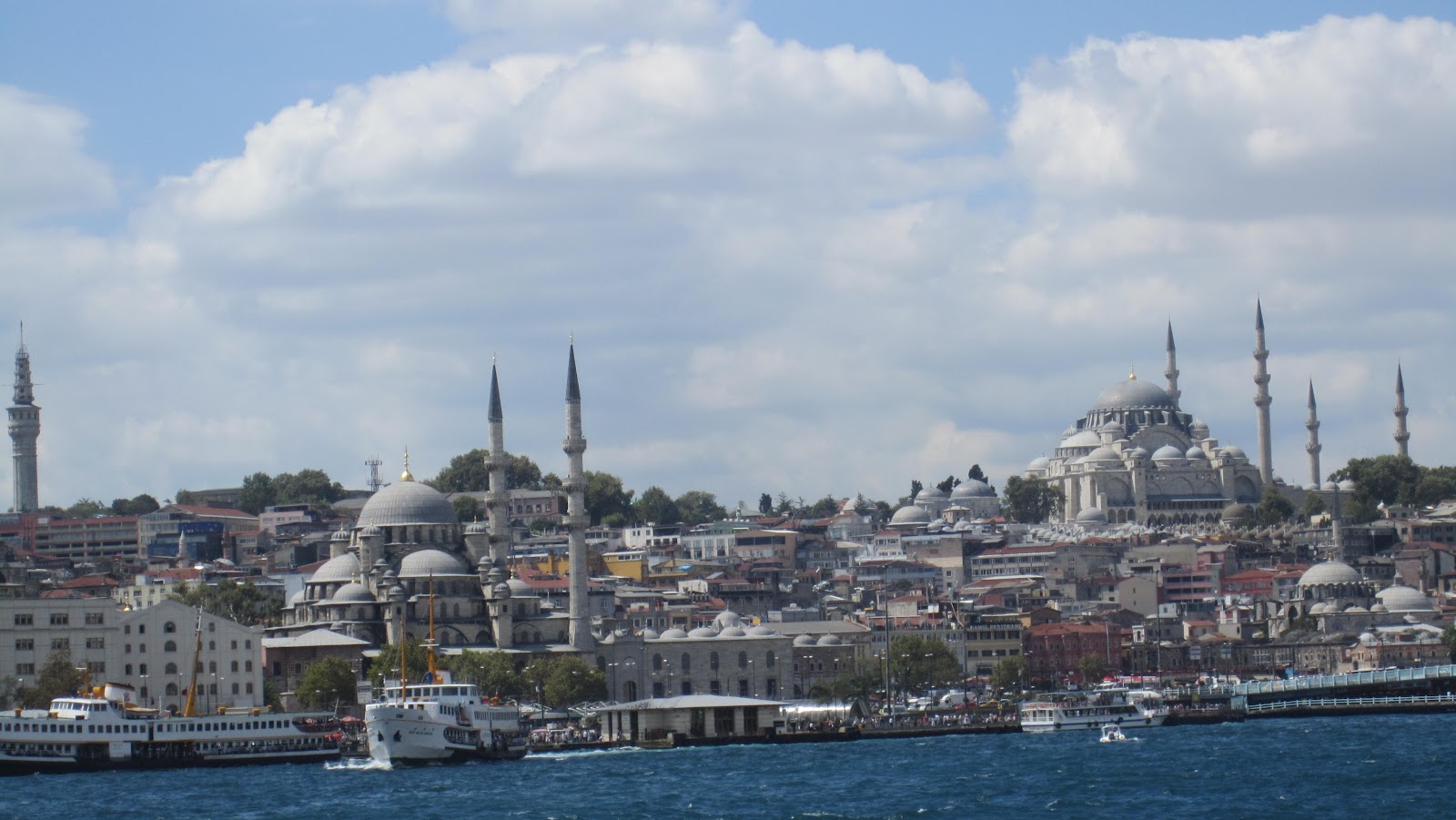
But none of this matters when you're on the water. I enjoyed an obligatory Bosporus cruise this morning, culminating in fabulous views of the hill where Suleyman the Magnificant built his mosque (the one on the right).


So I enjoyed hiking uphill through the neighborhoods to the mosque, which is famous for its intact kitchens (closed for renovation) and Suleyman's tomb (closed for renovations). But the mosque was beautiful and had great views back from whence I'd come.


I upheld tradition and had a nice time getting lost on the way back to my part of town. I stopped at a tea house to enjoy a traditional Turkish tea to revive my energy.  Sitting next to me were two symbols of the new Turkey: drinking strong tea in tulip glasses, puffing on their nargilehs, and using their iPads.


Tomorrow I catch an early flight to Izmir, on my way to Bergama, a town famous for the Roman ruins of Pergamon. I have no idea how I'm going to get from the airport in Izmir to Bergama, but I'm sure it'll all be clear when I get there.

Friday, August 31, 2012

Whew. I spent 5 hours today exploring the Topkapi Palace, the home of the Ottoman sultans from the 15th through the 19th century. It's no wonder the regents of Europe regarded the Ottomans as the pinnacle of civilization. Opulent doesn't begin to describe the palace, even now. Here is a sitting room, sideways (Got to figure out why these photos won't appear upright.)


The palace museum is vast, set on the confluence of the Bosporus and the Golden Horn, so the views are amazing. But much of the palace now lies outside the museum. This part of Istanbul is full of imperial buildings and gardens that have been taken over by the town. This park, for example, was once palace gardens, and the statuary is still there for kids to play on.


After recovering a bit, I set off for a walk and promptly got lost, of course. Somehow, I ended up at the "New" mosque, which is only 400 years old. I rested inside the courtyard and watched people get ready for the afternoon prayers. Mosques have washing areas, where devotees wash their hands, faces, and feet before going inside to pray.


Near this mosque is a huge nest of narrow lanes lined with shops and Friday, apparently, is shopping day. I braved the jammed streets and promptly got lost again.


I ended up in a specialized market, where you can buy any kind of small animal or bird and food for it, too. The grumpy man with the jars is selling leeches for medicinal purposes. The yellow pods on the right open up to some bright red seeds. I have no idea what the pods are, but they're eye-catching.


Tomorrow I'm going to ride the ferry up and down the Bosporus. My feet are ready for something else to cover the distance.

Thursday, August 30, 2012

I'm sitting on the rooftop terrace of my hostel in Istanbul, looking at the Hagia Sophia, Blue Mosque, and the moonlit Bosporus. The call to prayer has just started up from both of these mosques and a couple of others in the vicinity. It would be very atmospheric if the hostel's sound system wasn't playing retreads of 80s punk music.

I'm footsore and weary after  a very full day seeing all the obligatory sights, including the jaw-droppingly amazing places I just mentioned. Any self-respecting tourist would tell you all about the historic and cultural treasures I've seen.

But I know that you really want to hear about the food.

Here is lunch. I didn't really know what I was going to get, apart from vegetarian "kebap," but it turned out to be this excellent pureed eggplant dish. The red speckles on the onions are pomegranate flakes, which are a popular seasoning: very slightly tart and sweet.

Pomegranate is also used to make a popular drink, fresh squeezed as you watch.

I's a good thing that I like eggplant. because it's the foremost vegetarian option. I had it again for dinner, preceded by this traditional puffed bread with yogurt dip. The bread is hollow inside and crispy when you break it off.


(Don't ask me why this photo is sideways or why I can't rotate it.)

Oh, yes, I was going to give up drinking out of respect for Moslem culture, but here in this tourist quarter of oh-so-cosmopolitan Istanbul, full of barely dressed Aussie girls, I don't feel too scandalous having a beer with dinner.

Okay, you can't entirely escape culture. When they were digging around under the Blue Mosque, they found the remains of the 4th-century Great Palace of the Byzantine emperors. Fragments of the legendary mosaic floor were still there and were restored and moved to a museum. You can see the Greek and Italian influences in these delightful remains, even though they're sadly fragmentary.


More culture tomorrow, when I join the throngs at the Topkai palace.